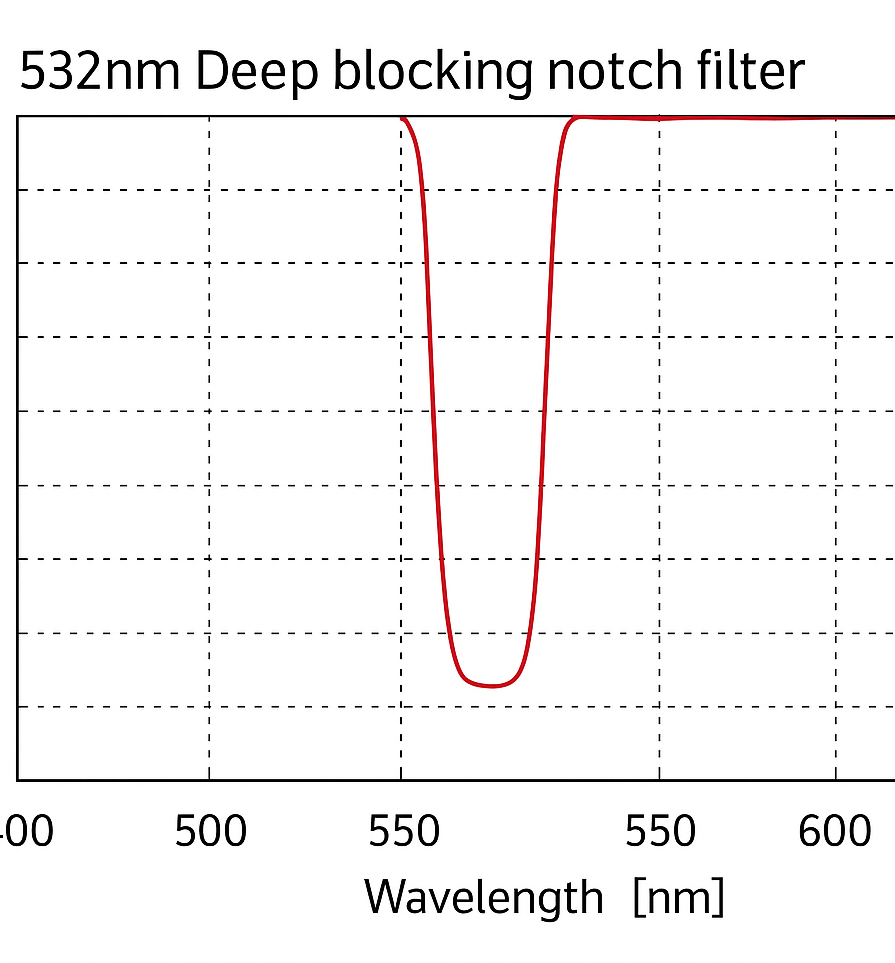
A Neutral Density (ND) Filter uniformly attenuates the intensity of incident light across a broad wavelength range without altering its spectral distribution. It is primarily used to control or balance light intensity for optical systems such as cameras, sensors, and measuring instruments — effectively compensating for detector or camera sensitivity. ND filters can be custom-designed to maintain a flat transmittance spectrum within any desired wavelength region — from ultraviolet (UV) to infrared (IR).
Types of ND Filters
| Type | Construction | Description / Notes |
|---|---|---|
| Reflective Type | Blocks one or more specific wavelengths (single or multiple notches) | Reflects part of the incident light to achieve optical attenuation; low absorption and excellent thermal stability |
| Absorbent Type | Applicable to UV, visible, and IR regions | Absorbs part of the incident light; often used for general-purpose visible range ND filters |
| Non-Reflective ND | Multilayer dielectric coatings (interference-based design) | Suppresses unwanted surface reflections while maintaining precise attenuation characteristics |
Applications
ND filters are widely utilized in fields requiring precise light intensity control:
- Light source dimming (lamp, LED, laser, etc.)
- Sensor or detector sensitivity adjustment
- Camera exposure control (photography, imaging systems)
- Optical measurement and calibration equipment
Optical Density (OD) and Transmittance Relationship
ND filter performance is typically specified in terms of transmittance (T%) or optical density (OD).
They are related by the following equation: OD=−log10(T/100)
| OD | Transmittance (T%) | Typical Use |
|---|---|---|
| 0.3 | 50% | Moderate attenuation |
| 0.5 | 30% | Visible light control |
| 1.0 | 10% | Strong light source dimming |
| 2.0 | 1% | Laser attenuation, precise optical calibration |